金流 FlowType 決策機制
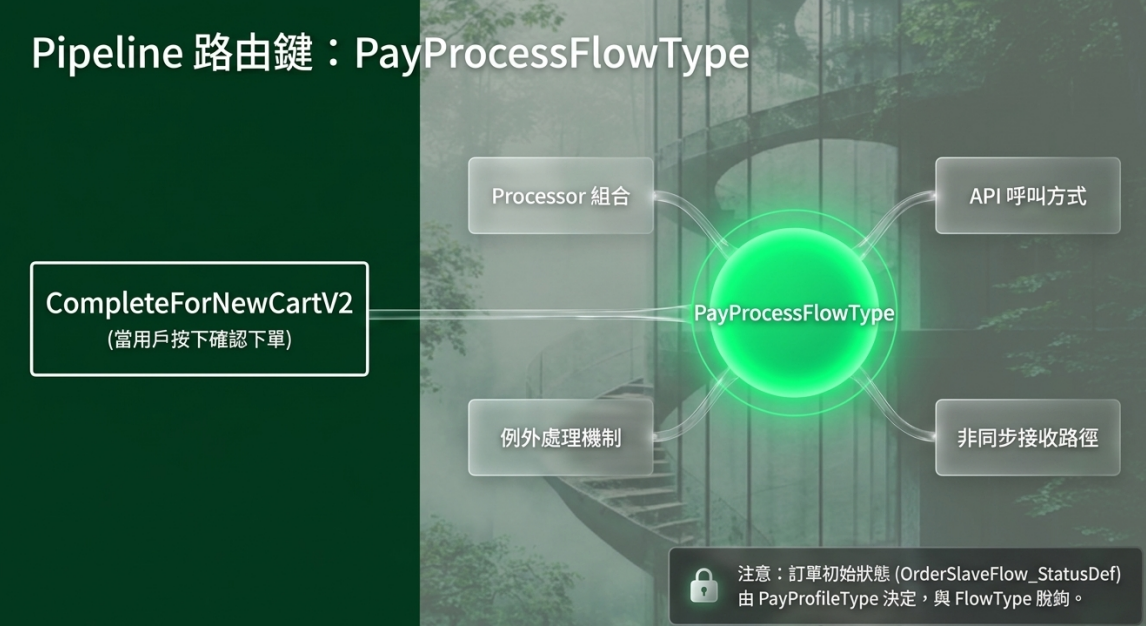
PayProcessFlowType 是 mweb 下單流程的 Pipeline 路由鍵
用戶按下確認下單後,CompleteForNewCartV2 做的第一件事就是讀取 context.PayProcessFlowType,然後決定要跑哪一套 Processor Pipeline
flowchart TD
    A["用戶確認下單"] --> B["CompleteForNewCartV2"]
    B --> C{"讀取 PayProcessFlowType"}
    C -->|ThirdPartyProcess| D["ThirdPartyProcess Pipeline\n34 個 Processors\n走 PMW 付款"]
    C -->|CreditCardProcess| E["CreditCardProcess Pipeline\n台灣信用卡直連"]
    C -->|LinePayProcess| F["LinePayProcess Pipeline\nLinePay 直連"]
    C -->|"AtmProcess / ShopProcess\n/ JKOPayProcess / ..."| G["各自獨立 Pipeline"]

    style D fill:#4A7CB5,color:#fff
    style E fill:#7B5EA7,color:#fff
    style F fill:#5BA85B,color:#fff
    style G fill:#888,color:#fff
FlowType 一旦決定,後面這些全部跟著走:
- 跑哪些 Processor(每條 Pipeline 組成完全不同)
- 用哪種方式呼叫金流 API(直連 / 轉發 PMW)
- 付款失敗、3D 驗證、Redirect 的處理方式
- Callback / QueryPayment 的接收路徑
Cart 專案的 GetPayDataProcessor,在用戶按下結帳的最前期就設定好了
flowchart LR
    A["Cart API\nCompleteCheckout"] --> B["Step 1\nMergeRequestAndOldPayProcessContextProcessor"]
    B --> C["Step 2\nCalculateShoppingCartPayPriceLimitProcessor"]
    C --> D["⭐ Step 3\nGetPayDataProcessor\nFlowType 在這裡決定"]
    D --> E["Step 4\nUpdateOrClearCacheBeforeComplete"]
    E --> F["context 帶著 FlowType\n傳給 mweb"]
    F --> G["mweb CompleteForNewCartV2\n執行對應 Pipeline"]

    style D fill:#4A7CB5,color:#fff
GetPayDataProcessor 的邏輯:
- 讀購物車的
SelectedCheckoutPayTypeGroup.StatisticsTypeDef(用戶選的付款方式) - 解析成
PayProfileType(e.g.CreditCardOnce_Stripe) - switch
PayProfileType→ 設定PayProcessFlowType
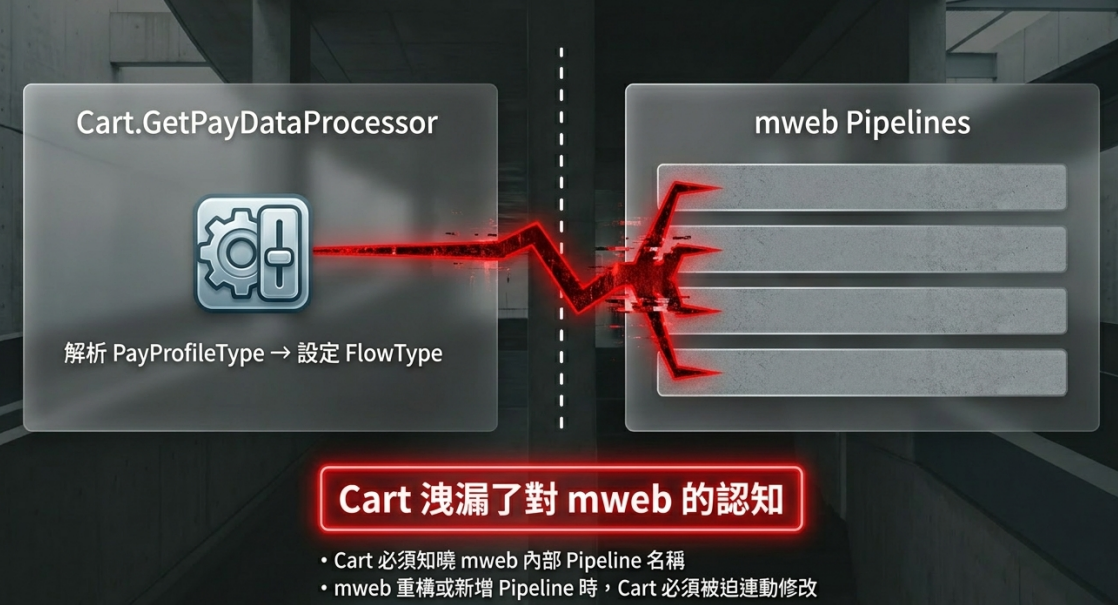
這個設計的問題:Cart 洩漏了對 mweb 的認知
FlowType 的語意是「mweb 要跑哪條 Pipeline」,這是 mweb 的內部實作細節。但現在 Cart 的 GetPayDataProcessor 卻持有這份 mapping,代表:
- Cart 必須知道 mweb 有哪些 Pipeline 名稱
- mweb 新增或重構 Pipeline 時,Cart 也要跟著改
- 兩個服務之間產生了隱性的結構耦合
flowchart LR
    A["Cart\nGetPayDataProcessor"] -->|"PayProfileType → FlowType\n(mweb 的 Pipeline 名稱)"| B["mweb\nCompleteForNewCartV2"]

    style A fill:#D9534F,color:#fff
    style B fill:#4A7CB5,color:#fff
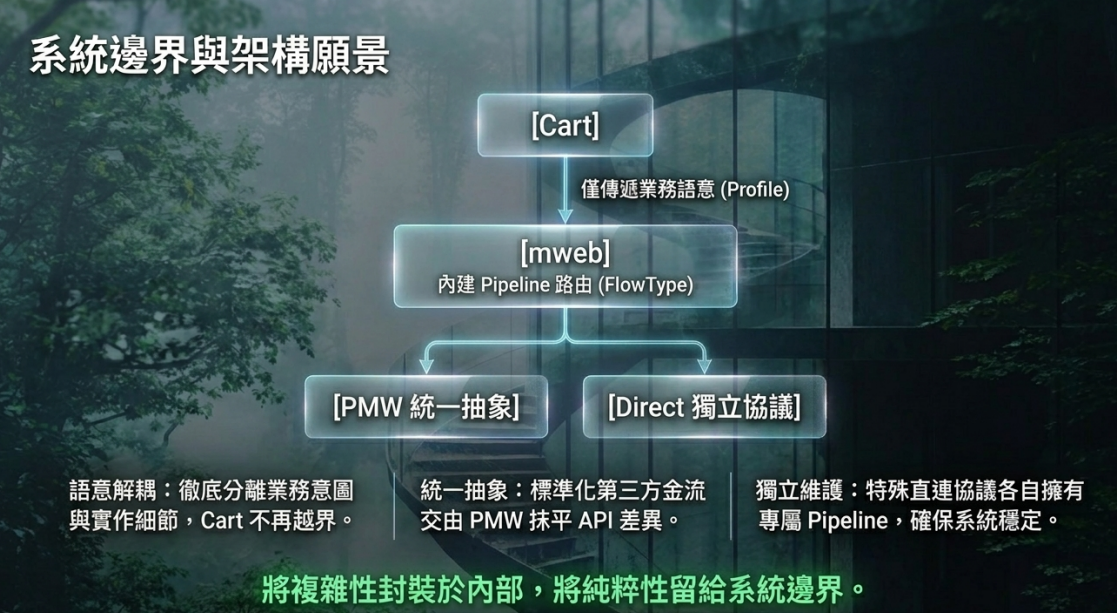
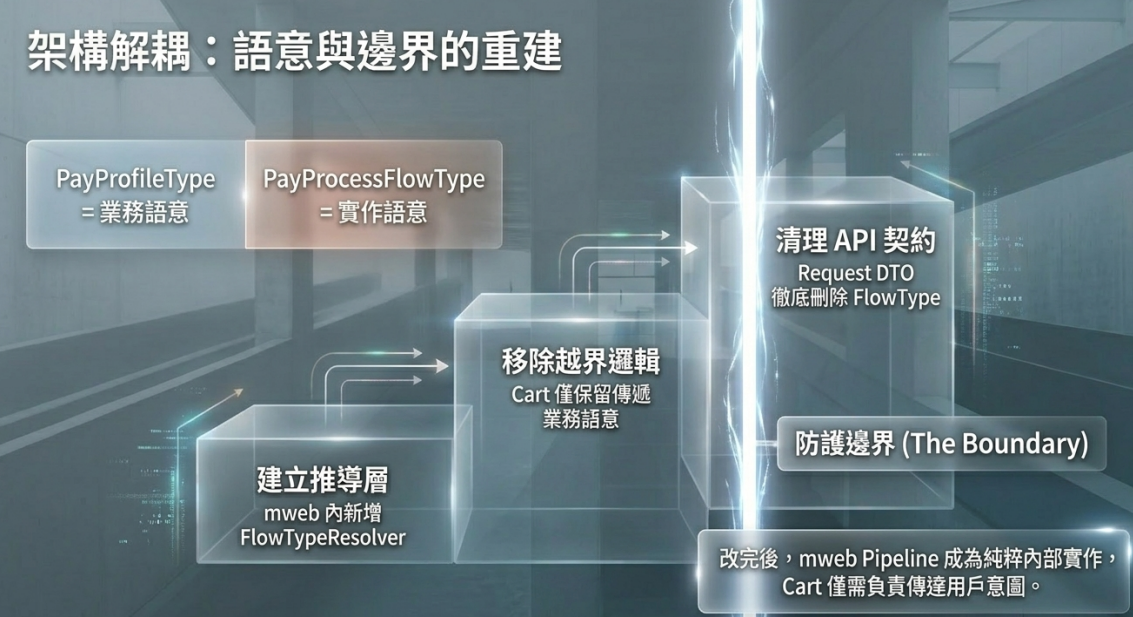
改善方向:Cart 只傳語意,FlowType 由 mweb 自己推導
PayProfileType 是業務語意(用戶選了什麼付款方式),FlowType 是實作語意(mweb 要走哪條路)。這兩個概念應該在 mweb 的邊界內完成轉換。
flowchart LR
    A["Cart\nGetPayDataProcessor"] -->|"只傳 PayProfileType"| B["mweb\nFlowTypeResolver\nPayProfileType → FlowType"]
    B --> C["CompleteForNewCartV2\n執行對應 Pipeline"]

    style A fill:#5BA85B,color:#fff
    style B fill:#4A7CB5,color:#fff
遷移步驟(不破壞現有行為):
- mweb 新增 FlowTypeResolver,在
CompleteForNewCartV2入口自行推導 FlowType,忽略 request 帶進來的值 - 確認行為一致後,Cart 的
GetPayDataProcessor移除 switch → FlowType 那段 - 清理 API Contract,將
PayProcessFlowType從 request DTO 移除
改完後,mweb 的 Pipeline 結構變成純粹的內部實作,Cart 只需要知道「用戶選了什麼付款方式」即可
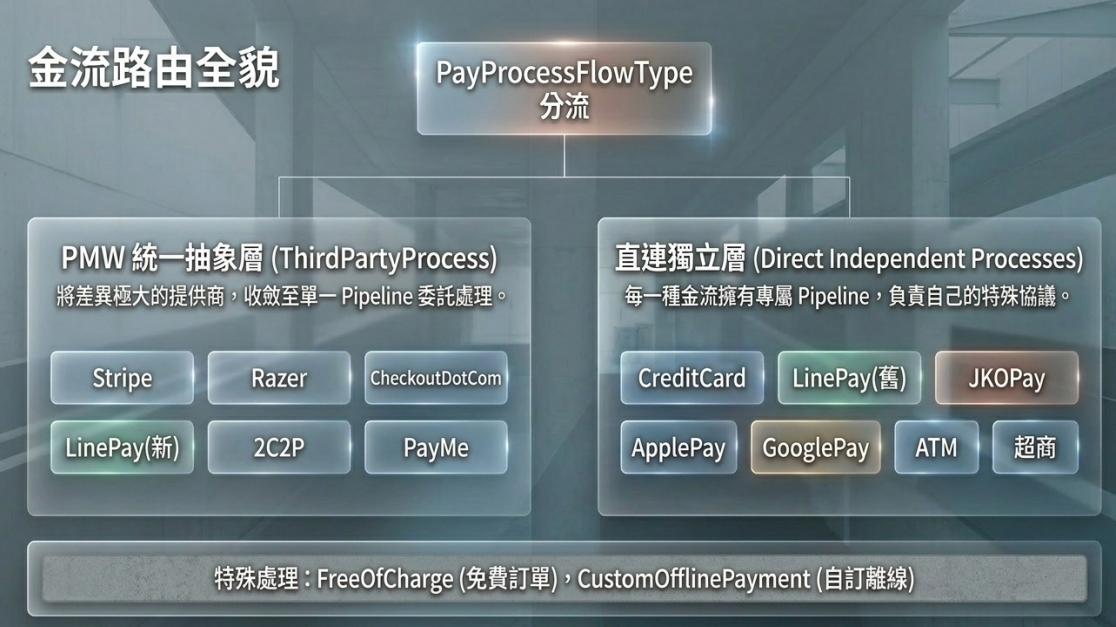
FlowType 全貌
| FlowType | 代表付款方式 | 性質 |
|---|---|---|
ThirdPartyProcess |
Stripe、Razer、CheckoutDotCom、AsiaPay、KPay、Cybersource、EftPay、SwiftPass、Atome、2C2P、QFPay、PayMe、LinePay(新)… | PMW 統一抽象層 |
CreditCardProcess |
CreditCardOnce、CreditCardInstallment(台灣) | 直連 |
LinePayProcess |
LinePay(舊) | 直連(逐步棄用) |
JKOPayProcess |
街口支付 | 直連 |
ApplePayProcess |
Apple Pay(TW) | 直連 |
GooglePayProcess |
Google Pay(TW) | 直連 |
GlobalPayProcess |
GlobalPay | 直連 |
CathayPayProcess |
國泰 Pay | 直連 |
PXPayProcess |
全聯 PXPay | 直連 |
AfteePayProcess |
Aftee | 直連 |
icashPayProcess |
icash Pay | 直連 |
EasyWalletProcess |
悠遊付 | 直連 |
PoyaPayProcess |
全聯 Poya Pay | 直連 |
AtmProcess |
ATM 轉帳 | 直連 |
ShopProcess |
超商取貨付款 | 直連 |
CashOnDeliveryProcess |
貨到付款 | 直連 |
FreeOfChargeProcess |
免費訂單 | 特殊 |
CustomOfflinePaymentProcess |
自訂離線付款 | 特殊 |
Stripe、Razer、CheckoutDotCom、EftPay、Atome 是完全不同的公司和 API,但它們在 mweb 眼中都走同一條 ThirdPartyProcess。
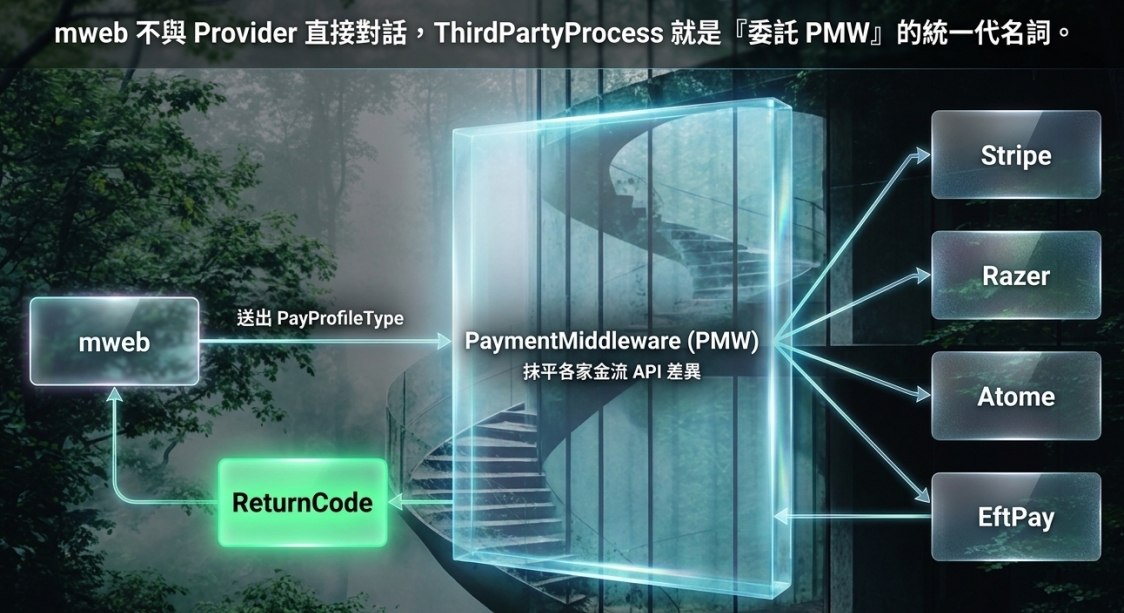
關鍵在於 mweb 不直接和這些 provider 說話,中間隔著 PaymentMiddleware(PMW)這一層。
flowchart TD
    A["mweb\nThirdPartyProcess Pipeline"] --> B["ThirdPartyPayApiProcessor"]
    B --> C["PaymentMiddlewareService\n.PaymentRequest()"]
    C --> D["HTTP POST\nPMW /api/v1/Pay/{PayProfileType}/{TGCode}"]
    D --> E{"PMW 根據 PayProfileType\n選擇對應 Plugin"}
    E --> F["StripePlugin"]
    E --> G["RazerPlugin"]
    E --> H["CheckoutDotComPlugin"]
    E --> I["EftPayPlugin\n..."]

    style A fill:#4A7CB5,color:#fff
    style D fill:#888,color:#fff
    style F fill:#5BA85B,color:#fff
    style G fill:#5BA85B,color:#fff
    style H fill:#5BA85B,color:#fff
    style I fill:#5BA85B,color:#fff
PMW 的職責就是抹平各家金流 API 的差異。mweb 只需要三件事:
- 知道「這筆要走 PMW」
- 把
PayProfileType傳給 PMW(讓 PMW 選正確的 Plugin) - 處理 PMW 回傳的統一結果格式(
ReturnCode)
所以 mweb 不需要為每個 PMW provider 各自建一套 Pipeline。ThirdPartyProcess 就是「委託 PMW 處理」的統一代名詞
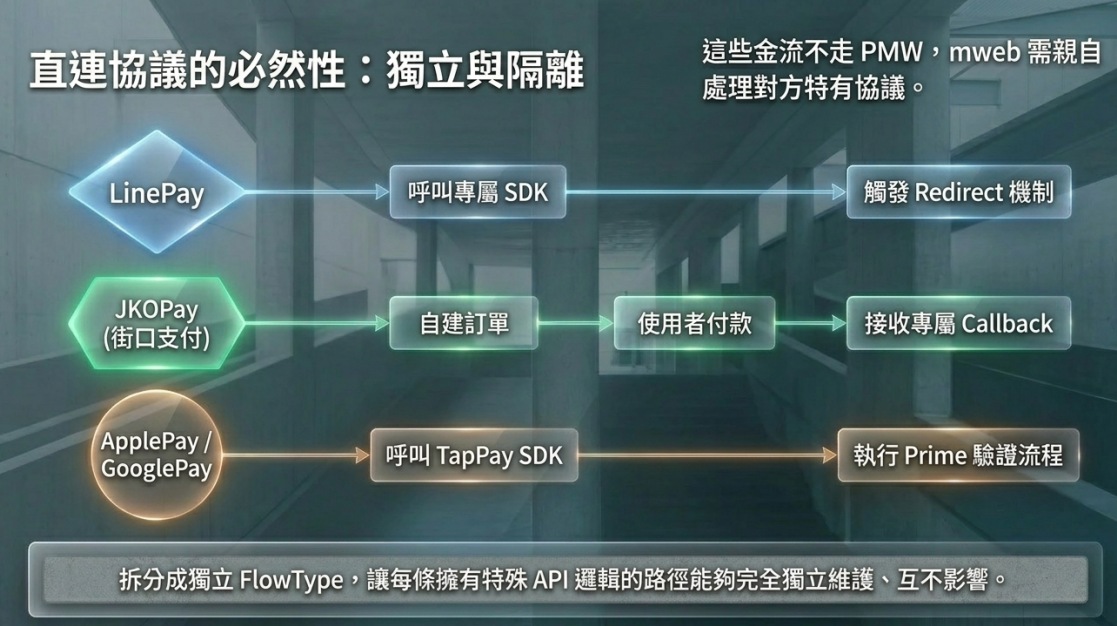
獨立 FlowType 的金流有一個共同特點:它們不走 PMW,mweb 自己負責與對方的協議
這些通常是在 PMW 架構成熟前就已整合的直連方式,每家差異太大:
LinePay— 有自己的 SDK 與 Redirect 機制JKOPay— 有自己的訂單建立 → 付款 → Callback 協議ApplePay/GooglePay(TW)— 走 TapPay SDK,需要特定的 Prime 驗證流程GlobalPay— 多種付款子類型(信用卡 / 網路銀行 / 電子錢包),各需獨立 Processor
因為每條流程的 Processor 組成和 API 呼叫邏輯都不同,拆成獨立 FlowType 讓每條路徑可以完全獨立維護、互不影響。
flowchart LR
    subgraph PMW["透過 PMW(ThirdPartyProcess)"]
        direction TB
        S["Stripe"]
        R["Razer"]
        C["CheckoutDotCom"]
        E["EftPay / Atome / ..."]
    end

    subgraph Direct["直連(獨立 FlowType)"]
        direction TB
        L["LinePay\n→ LinePayProcess"]
        J["JKOPay\n→ JKOPayProcess"]
        AP["ApplePay\n→ ApplePayProcess"]
        CC["台灣信用卡\n→ CreditCardProcess"]
    end

    mweb["mweb"] --> PMW
    mweb --> Direct

    style PMW fill:#E8F4FD,stroke:#4A7CB5
    style Direct fill:#FDF2E8,stroke:#D4813A